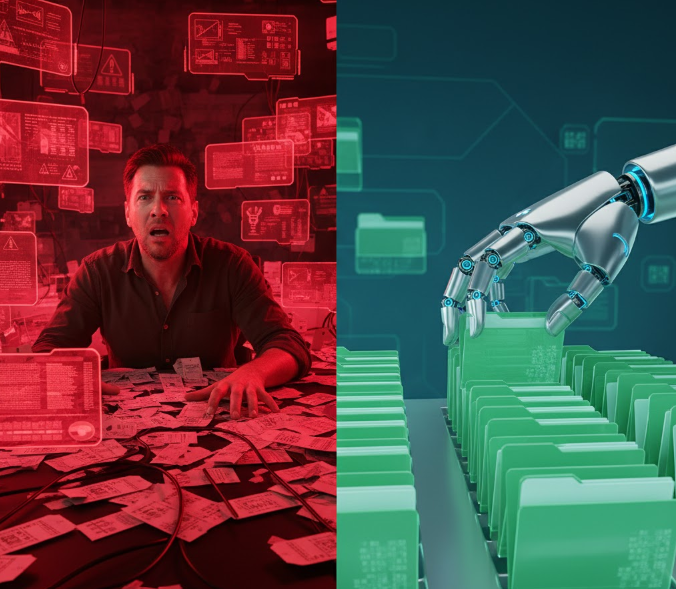
You know the vocabulary, you have the data, and you know how to triage an alert. But what happens when the alerts never stop? In the final chapter of our series, we explore how to save your sanity using automation and continuous improvement.
Welcome to the conclusion of The Watchtower Chronicles.
Over the last four articles, we built a Security Operations Center (SOC) from the ground up. We learned how to collect logs, write detection rules, and use the OODA Loop to investigate an attack.
If you were only defending a network of ten computers, you could stop here. But in the real world, enterprise networks have thousands of endpoints. That means your SIEM isn’t giving you one alert a day; it’s giving you thousands.
Today, we look at the reality of modern cybersecurity, the danger of burnout, and how we use robots to fight back.
The Invisible Enemy: Alert Fatigue
Before we talk about the solution, we must name the problem. It’s called Alert Fatigue.
Imagine working as a security guard, and your radio beeps every 30 seconds to tell you a leaf blew across the parking lot. For the first hour, you check the cameras. By hour four, you stop checking. By day three, you turn the radio off.
This happens to SOC Analysts every day. Industry research shows that modern enterprise SOCs can receive upwards of 10,000 alerts daily. The math is brutal: a human being simply cannot investigate that volume.
When analysts suffer from alert fatigue, two dangerous things happen:
- High Turnover: Analysts burn out and quit the industry.
- Missed Threats: Analysts start bulk-closing “Low Severity” alerts just to clear their queue. Attackers know this, and they specifically design their malware to blend in as “low-priority noise.”
To win, we can’t just work harder. We have to work smarter.
Enter the Machines: What is SOAR?
If the SIEM (Security Information and Event Management) is the brain of the SOC that sees the threats, SOAR is the hands that do the work.
SOAR stands for Security Orchestration, Automation, and Response. It is a software platform designed to take the manual, repetitive tasks away from human analysts.
It breaks down into three core powers:
- Orchestration: Connecting all your different security tools together via APIs so they can talk to each other (e.g., making your Firewall talk to your Antivirus).
- Automation: Executing tasks at machine speed without human clicks.
- Response: Taking action to neutralize the threat.
The Playbook: Automating the Triage
Let’s look at how SOAR changes the life of an analyst using our Phishing example from Part 4.
The Old Way (Manual Triage):
- Analyst gets a phishing alert.
- Analyst copies the suspicious IP address.
- Analyst logs into a threat intelligence website (like VirusTotal) to check the IP.
- Analyst logs into the email server to find who else received the email.
- Analyst logs into the firewall to block the IP. Time taken: 30 to 45 minutes.
The New Way (SOAR Playbooks): A “Playbook” is a visual, drag-and-drop workflow you build in your SOAR platform. You teach the machine how to do the steps above.
When the phishing alert hits the SIEM, the SOAR platform instantly triggers the Playbook:
- Extracts the IP and URLs from the email automatically.
- Enriches the data by automatically pinging VirusTotal for a reputation score.
- Quarantines the email from all user inboxes.
- Blocks the malicious IP on the firewall.
- Presents a neat, packaged summary to the human analyst to review.
Time taken: 15 seconds. The machine did all the heavy lifting. By the time the human analyst looks at the screen, the threat is already contained.
The Feedback Loop: Continuous Improvement
Automation isn’t a “set it and forget it” magic wand. A SOC is a living organism that must adapt. The final phase of mature security monitoring is Continuous Improvement.
When a major incident is resolved, the job isn’t over. The team must conduct a Post-Incident Review (sometimes called a Post-Mortem). You must ask:
- How did the attacker get in?
- Did our SIEM rules catch them fast enough?
- Did our SOAR playbook execute correctly?
This is where the entire cybersecurity lifecycle connects.
If you find a new blind spot during an investigation, you don’t just shrug it off. You take that new information and feed it directly back into your Threat Model (the blueprints we discussed in our very first article). You then use that updated model to conduct proactive Threat Hunting to ensure no other attackers used the same trick.
Conclusion: The Human in the Loop
It is easy to look at SOAR and AI and think, “Will this replace the SOC Analyst?”
The answer is No. Automation does not replace the human; it elevates them.
When you remove the burden of copying and pasting IP addresses 500 times a day, the analyst is free to actually analyze. They can step away from the reactive “alert treadmill” and step into proactive threat hunting. They can focus on the complex, stealthy attacks that require human intuition, creativity, and logic to defeat.
The Watchtower will always need guards. We are just giving them better tools.
Thank you for following along with The Watchtower Chronicles. Keep your models updated, trust your OODA loop, and stay safe out there.
Disclaimer
This article is for educational purposes. Implementing SOAR requires careful planning. Automating response actions (like blocking IPs or isolating servers) without proper testing and human oversight can accidentally cause massive business outages.
Leave a Reply