Ever hear the term ‘GRC’ and wonder how it connects to the daily alerts and tickets in your queue? This article breaks down Governance, Risk, and Compliance into simple, real-world concepts. We’ll move past the jargon and show you how the security tools you already use—from your SIEM to your email security gateway—are the engines that bring GRC to life, turning high-level policies into tangible protection for your organization
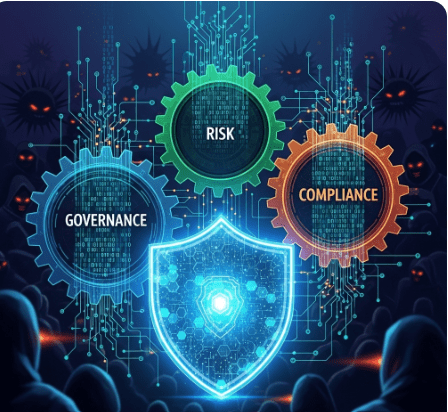
From Rules to Reality
As a cybersecurity professional, it’s easy to get lost in the weeds of technical troubleshooting. We live in a world of logs, alerts, and vulnerability reports. But behind all that technical work is a strategic framework called Governance, Risk, and Compliance (GRC). Think of it as the blueprint for your entire security program. In simple terms:
- Governance (G) is the set of rules and policies your company decides to follow. It’s the “what we must do.” For example, a policy might state, “All critical vulnerabilities on internet-facing servers must be patched within 14 days.”
- Risk (R) is the process of identifying what could go wrong. It’s the “what if?” This involves finding potential weaknesses, like an unpatched server or employees susceptible to phishing, and understanding the business impact if those weaknesses are exploited.
- Compliance (C) is about proving you follow the rules. It’s the “show me the evidence” part, often driven by external regulations like GDPR, HIPAA, or PCI DSS, or even internal audits.
Governance: Your Tools, Your Rulebook
Governance isn’t just a document that sits on a shelf; it’s actively enforced by your security stack. That high-level policy about patching critical vulnerabilities comes to life through your vulnerability scanner (like Nessus or Qualys). You configure the scanner with a policy that defines “critical” and sets the 14-day deadline. The scanner’s report is the technical enforcement of that governance rule. Another example? A governance policy might state, “No unauthorized software should be installed on employee laptops.” An XDR (Extended Detection and Response) solution enforces this by monitoring and blocking unapproved application installations, directly translating the written rule into a real-time action.
Risk Management: From “What If” to “What Now”
Managing risk is about visibility. You can’t protect against threats you can’t see. This is where your SIEM (Security Information and Event Management) solution is the star player. Let’s say you identify a risk of data exfiltration by an insider. Your SIEM doesn’t magically stop the person, but you can build correlation rules to detect suspicious behavior. For instance, you can create a rule that triggers a high-priority alert if a user who has given their two-weeks’ notice suddenly starts downloading large volumes of data from a sensitive server. Your IPS (Intrusion Prevention System) also plays a key role in managing risk by proactively blocking known attack patterns at the network edge, reducing your exposure before a threat can even reach a server.
Compliance: Showing Your Work with Logs and Reports
Compliance is all about providing proof, and your security tools are your primary evidence collectors. An auditor for PCI DSS (Payment Card Industry Data Security Standard) might ask you to prove that you are monitoring all access to your cardholder data environment. How do you do that? You generate a report from your SIEM showing that all relevant server logs have been collected and reviewed for the last 90 days. Similarly, regulations like HIPAA require protection around patient data. Your email security gateway provides the audit trail, proving that emails containing sensitive patient information were automatically encrypted based on your policy, thereby meeting the compliance requirement. Without the logs and reports from these tools, compliance would just be an honor system—and auditors don’t work on honor.
The GRC Flywheel: A Connected System
The most important thing to understand is that G, R, and C are not separate silos; they work together in a continuous cycle. A risk assessment might identify that phishing is your biggest threat. This leads to a new governance policy requiring multi-factor authentication (MFA) on all external services. You then implement and enforce this with your identity management tools. Finally, to meet compliance for an audit, you generate reports showing that 100% of users are enrolled in and using MFA. That compliance report might then feed into your next risk assessment, and the cycle continues. Your security products are the gears that keep this crucial flywheel turning, transforming high-level strategy into a defensible security posture.
 Secure Scroll
Leave a comment